
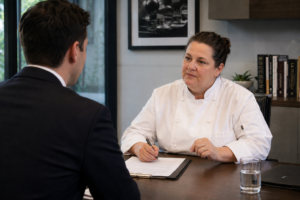
 I wrote a post Interview tips for chefs and cooks almost 16 years ago and quite a bit has changed since then but the topic is still being looked for as it’s one of the top traffic posts on my old blog. The post: Resume Writing Dos and Don’ts for Chefs and Cooks (written shortly prior to the above referenced post) was also a high performing post and I thought it was time to do a bit of an update on.
The basics I had covered prior still remain the same, but there are new things to think about since this was written. With the rise of more social media platforms and the use of AI, it’s a whole new world out there. While more experienced hospitality people may know all of this, I hope for anyone just starting out in the industry this is helpful.
The original post started because there was a discussion on a website called Cookwork.com (which is now no longer online) and it reminded me of what comes up frequently in discussions when I mentor young people thinking about going into the culinary industry: the old standby, writing a culinary resume.
Your resume is the first step to getting in the door to be interviewed, so you need to make it count.
Dos
Be Specific: If you worked the grill station or the sauté station, don’t just put: “Jane Doe Restaurant, December 12, 2005–October 15, 2006, Line Cook, I worked the grill station.”
What else did you do there? Any ordering? Did you check in orders? Did you help with inventory? Did you work any other parts of the line, even for brief stints? How many average covers did you do? What type of restaurant was it? If you worked grill, were you cooking fine dining, i.e., grilling ribeyes and salmon, or were you flipping burgers at a family-style restaurant? Did you expedite? Did you give direction to prep cooks or other staff? The more information you put, the more chance the person or persons reading your resume will see that you have done more than just “working the grill.”
Invest in some quality stationery if you are going for an in-person interview or mailing it; it will make your resume stand out from the crowd. While most places are accepting resumes by email or through digital formats where you either cut and paste your information into it or it gets pulled from a LinkedIn profile (if you have one), there is still the power of a good first impression.
While dropping off a resume is old school, there are still some small restaurants that do take them. Even if you have emailed or submitted a resume through an online portal, in my opinion it doesn’t hurt to follow up. It’s always a good idea to bring a good copy for a job interview too, first impressions count.
I mentioned investing in some quality paper for your resume and I shouldn’t have to mention this, but I will: dress up a little. You never know if you might end up talking to the manager or owner if you drop in unannounced, and this should go without saying, don’t drop in in the midst of the lunch rush or right before dinner starts. The 2:00–3:30 PM window is the sweet spot for lunch/dinner.
When I ran kitchens, I would occasionally have someone drop off a resume on their way to or from a cooking job while wearing their chef whites. Whether clean or not, wearing your chef whites (pants can sometimes be excused, but not a chef’s coat) out of the kitchen can leave not the best first impression on a potential employer. If your potential employer runs around with his or her whites on while out and about, you’re probably safe, but not all employers think like that. My first impression of a chef or cook roaming around (like pumping gas) with their whites on is, “Lovely cross-contamination we have got going on there…” when I see them.
And I will be the first one to admit, when I was in my late teens working in restaurants and very early twenties, before I knew any better, I thought grocery shopping or just running around in public outside of the restaurant environment with my chef’s coat on looked cool, until I worked for a chef that gave me a serious dressing down about it, but also took the time to explain from a sanitation perspective!
Don’t neglect your cover letter. Some online portals unfortunately don’t let you upload a cover letter, but the workaround is to combine it in the same document as your resume. Cover letters give you the opportunity to elaborate more: why did you get into the business, where do you want to end up someday, or what your passions are? It helps if you use the cover letter as a way to elaborate and enhance what is on the resume, versus just cloning the information and adding some wording around it.
I remember one of the best cover letters I ever got was when I was hiring for a sous chef many years ago. The applicant had not had management experience (yet) but was clearly very eager to learn and was straightforward about it, saying, “I want to own my own restaurant in the next 15 years.” The cover letter was real, it was honest and it wasn’t competing for my job right off the bat, and it didn’t regurgitate his resume, it enhanced it. He was one of the best hires I’ve ever made and he followed me to another restaurant when I got another job offer a few years later. He did end up owning his own restaurant eventually. It took a little longer than 15 years, but he successfully ran it for a few years and then went into catering so he could spend more time with his family.
Career gaps happen. Sometimes it’s not just from job loss and time spent job hunting, sometimes it’s an illness or a family member’s illness, and sometimes it’s because you are considering a career change. While I have seen some gaps put in as “self-employed” or “freelance,” unless you were actually doing that, it can come back and bite you in a job interview. If the gap was for a specific reason, I’ve found it does help to be direct. “Planned career break” or “Caregiving” or “volunteering or nonprofit work” (make sure you list it) or “Took courses, certifications or bootcamps” (and again, make sure you list anything). When it comes to being laid off, this is not something to be embarrassed about. It happens. I wouldn’t include it in a resume but might in a cover letter and be prepared to talk about it.
I’ve seen some career articles and posts (and AI suggests it if you ask) recommend putting month-to-month or year-to-year dates to close gaps between jobs. For example, you left one job in June and found another job in September. The suggestion being end one job in July and begin another in August. Yes, it does look better on a resume, but what happens when that information gets checked?
Many HR and hiring people do look at people’s LinkedIn accounts (I absolutely do when vetting people) and compare them to a resume. Mismatches of dates and job descriptions cause red flags, so make sure your resume matches your LinkedIn profile.
Run spell-check, and then run it again, and THEN run it by an English major if needed. AI can certainly help proof things in a pinch, BUT be wary of it not understanding restaurant terminology or rewording things that may not necessarily mean what you put in originally. Spell-check does not catch everything! Your future employers won’t be impressed with a resumah with mispeled wurds and in my own case I tend to duplicate words or have misplaced verbs sometimes because of neurodivergence (I prefer neuro spicy) and that often doesn’t get caught.
If you have computer knowledge, list it and the programs you know as well. While you might be interviewing for a line cook or sous chef position where you may not be using a computer at first, think long term (because your potential employers will be). If you get promoted, you may be asked to program or change information in the POS system or use Excel to manage inventories or scheduling. More and more POS programs integrate inventory control into their systems.
If you have certifications or other relevant experience that is not directly job-related but is industry-related, list it. As a potential employer, I want to know if you have your current and up-to-date ServSafe certification and T.I.P.S. training, for example.
List any memberships you have if they are industry-related. Are you a member of the ACF? Did you belong to a food and wine club at your high school or college? As a potential employer, I like to know that you are interested and involved in the industry.
- Use bullet points.
Make sure your typeface is clean and easily readable. While calligraphy fonts are beautiful, they can also be very hard to read.
Customize your resume for each employer. A resume for a corporate job should not be the same as one for a small fine dining restaurant. Heavily research your targets and the job you are applying for, and customize accordingly. This can also include rearranging the order in which you list your categories. For a corporate-type job, you may want to list your schooling and certifications first and then your job experience, whereas for a small restaurant that is looking for a saucier, your job information should come first. Especially any information such as being a saucier should be highlighted.
It’s suggested in most professions not to list all your job experience. In the case of the hospitality industry, I don’t necessarily agree with that. More than 20 years back is a bit much, but you may want to list places you worked and job titles and if you are looking for upper management roles, I’ve been finding age is less of an issue than in other industries, especially ones where you are dealing with a lot of paperwork and management duties. The restaurant industry has much more variety than many other industries, such as computing. As a potential employer, I would want to know that 15 years ago you worked at an Asian restaurant rolling sushi.
Keep your resume to two pages or less if possible. A third page can be used as a promo page if you use it for “extra” information, i.e., any culinary awards you have won or if you were written up in news or other media. Be careful of being too self-promotional, though. But it can be a relevant push for a callback, depending on where you are applying. As an employer at a high-end seafood restaurant, the fact that you won the Boston ACF Seafood Challenge for three years running gives you some positive points in my book.
When using phrases like “Increased table turnovers” and “Improved food cost,” give specifics, i.e., “Improved food cost by 12% by re-sourcing vendors over a six-month time period.” (This goes for writing your cover letter as well.) Give specifics. Numbers are important; otherwise, it’s just empty hype.
“References available on request” is a bit outdated and yet I still see it show up on resumes. If you have references, give them with the resume/cover letter. As someone who influences hiring, I’m still going to call your last 3 to 4 jobs regardless of whether you gave them as a recommendation or not, and depending on whom the recommendations are from, I may selectively call them and I will certainly drill into how they know you. Was it a professional relationship or is this a buddy? It’s pretty easy to tell when you ask pointed questions.
If you are just starting out and don’t have job references yet, ask high school teachers and other adults who are business owners who know you if you can use them as references. If you are just graduating from culinary school, many culinary teachers are happy to write letters of reference as well if you are an exceptional student.
Do be persistent and follow up. If you mailed or emailed your resume to a restaurant or other facility and feel you are qualified for the position you are applying for, give it about a week and follow up, preferably with a polite phone call.
Don’ts
If you only have one copy left of your resume and the original is gone, spend the time to retype it. Don’t photocopy it.
Don’t put your “cute” email address as a contact source. While they may be amusing to you and your friends, they are not amusing to a potential employer. Get a Gmail account or a second one, and sign up with a more straightforward address. Some real-life examples of resume email addresses I have gotten (and my impression of the person dropped several points just from the address): hotcrossbuns@, sexychefette@, sexkitchenkitten@, smokintoquen@, angusbiteme@, chocolatemeltsme@, OhU8me2@, and thanks to ChefCody on cookwork.com for these: staightupg09@, youcanthandletheangus@, livingthe420dream@, whateva504@, Pinkfender2@, chancethepants@, exodabeast@.
Don’t list generalities (“a good problem solver,” “great under pressure,” “hands-on”) are like saying “Improved food cost.” These have no relevant basis unless you can back them up with relevant examples.
Don’t apply for jobs that you are not qualified for and then be upset when you don’t get callbacks and call the employer to harass them about it. Most employers will keep good resumes on file for future needs. While I may not need a line cook right now because I need an executive chef, I will probably keep your resume if it’s a good potential future hire. If you call me and inquire why I didn’t call you back and try to convince me that working at Denny’s for two years qualifies you to be my executive chef, your resume likely won’t stay on file long and I may block your cell number.
Don’t use words you don’t know the meaning of. “I worked the Garde Manger station” (but have no idea what Garde Manger actually means).
Don’t use words that you don’t know how to spell correctly. I still, to this day, wonder what a “bay marie” is. (I can forgive the “baine” vs “bain” spelling.) This one is a bit like Duck/Duct Tape.
Don’t fib! Those “little white lies” will definitely come back to haunt you in this business. Saying you made a 30-yolk hollandaise by hand daily and then not being able to incorporate an egg yolk when asked doesn’t look good. (This goes for your interview as well.) Telling an interviewer that you oversaw the whole kitchen staff of 12 when you were really just a prep cook is a stretch, and most people DO check. When I check resumes, my number one question to references people have worked for is, “Would you hire them back?” If there is a hesitation, it’s a check mark down for “Why not?”
If you write a career objective, consider who is going to be reading your resume. “I would like to gain as much experience in the restaurant industry as I can by working all the stations and positions available to me and would like to eventually own my own restaurant” is a decent, if unimaginative, career goal. “To advance myself through the ranks of the ___ Restaurant and in two years replace the executive chef who is there now” is not a great (but real-life) example of a good career objective, especially in the particular case where the person reading the resume was the executive chef.
Don’t have AI write your resume for you or your cover letter. I use AI, but I also want to be cognizant of the environmental impact of AI use so I try to use it only when necessary. The downside of having AI write it for you is that many ATS systems use advanced AI tools now (some had prior before but now it’s most of them) and I’ve talked to several HR professionals who said their systems flag resumes that are suspected of being completely AI generated. Unfortunately I have yet to find an AI that doesn’t incorrectly flag authentic writing, especially if you are a good writer. Keep in mind, AI platforms were trained on excellent writers.
The biggest issue with AI-written resumes is it’s not really you. It tends to embellish and also make assumptions. I’ve seen several recent resumes that clients have sent me to take a look at and then participated in interviews with the potential staff where clearly the resume was over-tweaked by AI. AI is a great tool, it’s not a crutch. If you must use it, use it to check grammar and spelling, ask it to analyze what you have (please strip out identifying personal information) and give you feedback on improvement.
Other Tips
If you are going to put your social media links on your resume, two things.
One: Why? Is it because you have YouTube or TikTok videos plating and/or cooking and it shows you can work the line or create excellent plate presentations? Or…
Two: I bring this up as I have seen a trend recently in resumes where applicants are adding all of their social media links. As someone who vets resumes for some clients, I do track down and look at what’s public on socials (links provided or not) and give feedback to the client on what I find.
I’ll use a recent example of a person applying for a Sous Chef position whose resume I looked at for a client who actually provided their Instagram account on their resume. In checking out the link I saw a bunch of photos of the cook clearly drinking alcohol while on shift during service and horsing around with fellow cooks. Four words: raised concerns about professionalism.
I get it, I get the industry, I’ve been in the industry for decades and I’ve seen just about everything in this industry. But for heaven’s sake, clean up your socials and don’t specifically draw attention to them unless it’s relevant.
I have seen an uptick in video resumes and reels and videos being used to highlight skill sets like plating, but please PLEASE match the videos highlighted to what you are applying for. A gorgeous charcuterie board isn’t going to impress a family-style restaurant and taking 5 minutes to plate a beautiful dish isn’t going to endear you to the grill or fast-casual restaurant that burns through 500+ covers a night. I bring these up as examples because both were highlighted in cover letters I’ve seen in the past year and the videos, while very well done and highlighting beautiful food, didn’t match the type of cuisine and jobs that the cooks were applying for.
I’ll add one more. In this day and age and political climate, unless you don’t care and that’s really up to you, please keep in mind the hiring manager or owner of a restaurant, hotel or other food service facility may not have the same political leanings as yourself. I know it shouldn’t be a factor in hiring, but I am a realist, and the reality of it is that it is and it can be.
I have seen people that have great skill sets passed over based on what they post publicly on social media. I very much respect the right to free speech but the reality of it is it can influence hiring. And again, if you don’t care, that’s entirely up to you. While some states have protections against political discrimination, not every state does and I think it would be very, very hard to prove in court.
ATS Systems (Applicant Tracking Systems) have been in use for many years, but now with more ATS systems using advanced AI to filter job applications, using keywords in your resume is important but also be very, very careful of keyword stuffing. In the old days people used to place keyword blocks underneath their resumes and then make the text white to try to fool the ATS systems into thinking it was a “good” resume. While that rarely worked, it definitely does not work now.