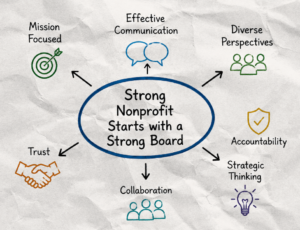
 I’ve been doing a lot of consulting and providing feedback recently, both through my own business and through free nonprofit business mentoring. Board dynamics, IMO, are something that can help or very much hinder the organization and running of a nonprofit. I have seen the gamut, from healthy boards where the Executive Director is in the loop on everything to seriously dysfunctional boards with lots of infighting, cliques, and miscommunication between not just board members but board and staff, and vice versa.
When working with dysfunctional boards, I’ve found doing a S.W.O.T. analysis of both board makeup and, separately, board dynamics very helpful. I also like to have board members do an individual S.W.O.T. on themselves. Most people find it quite eye-opening when they start to analyze themselves strategically.
I also find anonymous surveys very helpful, especially if it’s a bigger board and have the executive committee review it or have an external source review (recommended for nonbias). For a smaller board especially, have someone who does not have does not have a stake in any outcomes or doesn’t have direct involvement in the board, be the evaluator and aggregator of information so that any identifiers (even if anonymous) are stripped out.
I put these questions into Google Forms and have it set so that email addresses are not collected to maintain anonymity.
The full document and questions are way over the average length of what I would usually suggest for a survey, so either let people know upfront that it’s long and to set aside time specifically for it, typically, it takes between 20 minutes and half an hour to fill out fully, or break it into several smaller surveys so it can be “digested” separately.
The funny thing is, the last time we broke it up individually for a board I was working with, the board balked at doing the whole thing at once, but almost everyone sat down and did all the separate surveys at the same time. Perception is such an interesting thing.
The survey covers:
- Overall Board Effectiveness
- Board Composition & Recruitment
- Meetings
- Board Culture
- Mission and Direction
- Board Leadership
- Executive Oversight
- Individual Participation
- Committees
- Governance
- Looking Forward
Some tips: If you do use Google Forms for this, the repeated question, “If you answered Neutral, Disagree, or Strongly Disagree, can you elaborate on why you selected that rating?” make these all required or at least the Disagree, or Strongly Disagree. Finding out the good, the bad, and the ugly is the first step in figuring out where to start to make a more cohesive and productive board.
Test the form several times for usability and to make sure choice selections work. If you have never used Google Forms before (it’s free), there are some great walkthroughs and tutorials at Google’s Forms training pages.
Please feel free to take and adapt this to suit your nonprofit’s needs. This has been tested for use before and works well at digging into the matter when it comes to boards helping to identify their strengths and address areas that need improvement.