by Heather T. | Oct 1, 2025 | Nonprofits, Observations
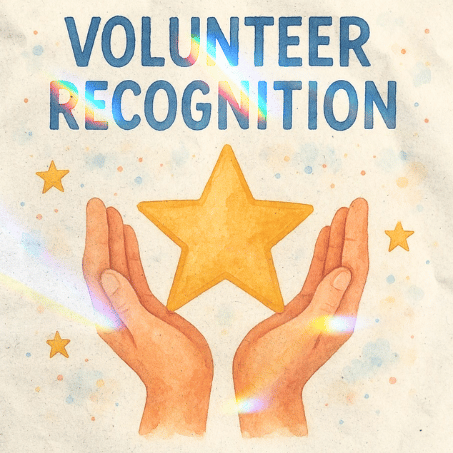 Volunteer recruitment and retention continues to get harder and harder. People are busy, stressed, and may not feel like volunteering or continuing to volunteer, particularly if they feel unappreciated.
Volunteer appreciation needs to be ongoing, and it doesn’t have to be time-consuming. A nonprofit doesn’t have to spend a ton of money on appreciation. It’s the small things that make a difference. The value of the THANK YOU is priceless. I created this list this summer when I did a session for the NH Governor’s Conference on Volunteerism, which was on Recruiting and Retaining Volunteers for Non-profits.
While there are dozens of lists out there about volunteer recognition, this is my list, including a few don’ts at the end. AI can spit out endless lists of ideas for recruitment and retention, and it can be a great starting point, but it lacks the human experience element. And if you ask it to give you ideas, please take with a grain of salt and ask yourself, would your volunteers truly appreciate this AND if you were the volunteer, would YOU appreciate it?
AI is a great tool, and I’ve said it before and will say again, don’t use it as a crutch. GIGO, Garbage In, Garbage Out. “Gift them a single paperclip with a note: “You hold us together.”” 🤣🤣🤣This was a sample volunteer appreciation suggestion from ChatGPT. All I can say is, if I got that from an organization I volunteered for, I wouldn’t think highly of it. At least give me a small box of unique paperclips; I’d at least feel there was some thought put into it.
RECOGNITION & GRATITUDE
- Send handwritten thank-you notes. Branded note cards are encouraged. You can buy blank note cards at office supply stores or online and print in house.
- Give shout-outs during meetings. Be specific and make sure you make a point to try to callout/shout out people that may not necessarily be getting a lot of recognition otherwise. Volunteer leaders are typically the ones who don’t seek recognition and also don’t get it which can cause long term resentment and disconnection from the cause.
- Post public acknowledgments on social media. Ask before using names and photos. Best practice is to have a photo and name release for all volunteers.
- Highlight a volunteer of the month. Try to rotate people of all genders. On socials, in newsletters, in office bulletin boards and on a website.
- Write a feature or volunteer bio in your newsletter, weekly, monthly or quarterly.Use a Google form (free) and ask volunteers when they start volunteering to fill out some quick questions. This helps to let volunteer leaders know a little more about the volunteer and connect with them better.
- Hand out “caught being awesome” or “Thank you for being an awesome volunteer” cards. Including a small Dunkin Donuts $5 coupon is also a nice touch.
- Host a small thank-you breakfast once a month. Make it personal, bring something home-made or something unique and delicious from a local bakery.
- Send appreciation text messages. Text messaging for people who don’t do a lot of text messages can be time consuming and difficult to draft and the chance of typos can increase. Drafting your messages in MS word helps personalize and make sure the volunteer’s name is spelled correctly. It’s easy to copy into an email and send it to yourself and then paste into a text message.
- Create a thank-you video from the Executive Director, staff and Board of Directors. Make sure everyone knows how to pronounce the volunteers name correctly.
- Mention volunteers in press releases. Don’t just mention names (again have permission) mention what they do and their impact.
- Give a round of applause at events. Make sure to recognize some specific people.
- Celebrate anniversaries of their service. Don’t just do 5 years, 10 years. Do a one year and call out volunteers and highlight personal impact stories.
- Send surprise “just because” cards. Pick a volunteer randomly once or twice a week (keep track). 2 minutes of your time.
- Share positive quotes with a note of thanks. Carry the above one step further, those quotes are meaningful.
- Recognize birthdays with a card. Capture that information (just day and month not year) when you onboard them.
- Tag them in thank-you posts online (with permission). Take it one step further and find out which channels they frequent the most.
- Nominate them for community awards. In New Hampshire for example, we have state volunteer awards (Volunteer NH). Most states and even nationally have recognition that you can nominate those who give “more”.
- Post “volunteer of the week” on internal bulletin boards. (If you have a brick and mortar space)
- List your volunteers (with permission) in your annual report. (The more places your volunteers are recognized the better, online, offline and verbally)
The next post will focus on Comfort & Hospitality and Meaningful Gestures, followed by a post on Fun and Celebration, and last but not least Gifts & Tokens and Volunteer Recognition Don’ts.
by Heather T. | Jun 19, 2025 | Nonprofits, Observations, Operations
 I am on several non-profit boards and over the years, through my business and as a small business mentor, have worked with many non-profit boards.
These are the interview questions and checklist I use when vetting new potential board members. Please feel free to copy and customize to suit if you find it useful.
Checklist for Vetting/Interviewing New Non-Profit Board Members
Interviewers:
Date:
Initial Screening
Application/Resume Review:
☐ Confirm the receipt of application or resume.
☐ Check for relevant experience and skills.
☐ Review LinkedIn and other public social media platforms for relevance.
List links found:
Alignment with Mission:
☐ Assess the candidate’s passion and commitment to the organization’s mission.
Very Passionate Passionate Indifferent Not Significantly Interested
Availability:
☐ Confirm the candidate’s availability for meetings and commitment to board responsibilities.
List Dates Discussed and Agreed on:
Notes:
Secondary Screening/Interview
Qualifications and Experience
Professional Experience:
☐ Review the candidate’s professional background for relevant experience (e.g., finance, legal, marketing, fundraising).
Non-Profit Experience:
☐ Check for previous experience with non-profit organizations or boards.
List experience:
Skills and Expertise:
☐ Identify specific skills the candidate brings (e.g., strategic planning, governance, community outreach).
List attributes:
Notes:
Personal Attributes
Leadership Qualities:
☐ Evaluate the candidate’s leadership and teamwork abilities.
List attributes:
Ethical Standards:
☐ Assess the candidate’s integrity and ethical standards.
List attributes:
Communication Skills:
☐ Check for effective verbal and written communication skills.
Cultural Fit:
☐ Determine if the candidate’s values align with the organizational culture.
Yes No Unsure
Notes:
Commitment and Availability
Time Commitment:
☐ Confirm (again) the candidate can commit the necessary time for board meetings, committees, and events.
Long-Term Engagement:
☐ Assess the candidate’s willingness for long-term involvement.
Notes:
Financial and Legal Responsibility (for treasurer/secretary roles)
Financial Literacy:
☐ Ensure the candidate understands financial statements and budgeting (particularly for Treasurer candidates).
Legal Awareness:
☐ Verify the candidate’s knowledge of non-profit governance and legal responsibilities.
Very Aware Somewhat Aware Needs Some Training Needs Significant Training
Notes:
Conflict of Interest
Potential Conflicts:
☐ Identify any potential conflicts of interest with the candidate’s professional or personal life.
List if found:
Disclosure Agreement:
☐ Ensure the candidate is willing to sign a conflict of interest disclosure agreement.
Notes:
References and Background Checks
Professional Non-Profit References:
☐ Collect and verify professional references.
List references:
Sample questions to ask references:
- How do you know “name”, and in what capacity have you worked together?
- How long have you known them, and how closely did you work together?
- Did “name” serve on your board or another committee? If so, what was their role or roles?
- How would you describe their level of participation and reliability in meetings or projects?
- Was “name” involved in fundraising, advocacy, or donor relations? How did they perform?
- How did “name” interact with fellow board members, staff, or volunteers?
- Did they handle conflict or differing opinions constructively? Can you give an example?
- Would you say “name” demonstrated high ethical standards and followed through on commitments?
- Were there any concerns or challenges you observed during their time with your organization?
- Would you recommend this person for a nonprofit board role? Why or why not?
- Is there anything else we should know about “name” that would help us make an informed decision?
- If there was an opportunity to have them back on your board in some capacity would you want them back?
Background Check:
☐ Conduct a criminal background check if necessary.
Notes:
Interview Process
Interview Preparation:
☐ Prepare a list of interview questions focused on experience, skills, commitment, and values.
Nonprofit Board Member Interview Questions (customize to suit)
Personal Information
Name:
Address:
Phone Number:
Email Address:
Background and Motivation
- Why are you interested in joining the board of our nonprofit?
- What do you know about our organization and its mission?
- What motivates you to contribute your time and expertise to our cause?
- Have you had any previous involvement with our organization? If so, please describe.
Skills and Experience
- Please provide an overview of your professional background and current occupation.
- Do you have any prior experience serving on a non-profit board? If yes, please provide details (e.g., organization name, role, duration).
- What specific skills or expertise do you bring to our board? (e.g., fundraising, finance, marketing, legal, strategic planning)
- Can you provide examples of how you have used these skills in a nonprofit or volunteer setting?
Commitment and Expectations
- Board members are expected to attend regular meetings and actively participate in committee work. Are you able to commit to this level of involvement?
- How much time per month can you realistically dedicate to board activities?
- What are your expectations from the organization and fellow board members in terms of support and collaboration?
Fundraising and Advocacy
- Fundraising is a critical aspect of board responsibilities. Are you comfortable with and experienced in fundraising activities?
- Can you share any successful fundraising experiences you have been involved in?
- How would you leverage your network to support our nonprofit’s fundraising goals?
Strategic Vision and Leadership
- How do you see the nonprofit landscape changing in the next 5-10 years, and how should our organization adapt?
- What ideas do you have for improving our organization’s impact and outreach?
- How do you handle conflict or differing opinions in a group setting?
References: Please provide contact information for at least two professional references who can speak to your qualifications and experience.
Interview Panel:
☐ Assemble an interview panel of current board members and/or executive staff.
Interview Evaluation:
☐ Use a standardized evaluation form to rate the candidate’s responses and overall suitability.
Notes:
Final Decision
Board Approval:
☐ Present the candidate to the full board for approval.
Official Invitation:
☐ Send an official invitation to join the board upon approval.
Onboarding Plan:
☐ Prepare an onboarding plan including orientation and introduction to the board and organization.
Sample Evaluation Form for Interviews
| Criteria |
Excellent |
Good |
Fair |
Poor |
|
| Professional Experience |
☐ |
☐ |
☐ |
☐ |
|
| Non-Profit Experience |
☐ |
☐ |
☐ |
☐ |
|
| Skills and Expertise |
☐ |
☐ |
☐ |
☐ |
|
| Leadership Qualities |
☐ |
☐ |
☐ |
☐ |
|
| Ethical Standards |
☐ |
☐ |
☐ |
☐ |
|
| Communication Skills |
☐ |
☐ |
☐ |
☐ |
|
| Cultural Fit |
☐ |
☐ |
☐ |
☐ |
|
| Time Commitment |
☐ |
☐ |
☐ |
☐ |
|
| Potential Conflicts |
☐ |
☐ |
☐ |
☐ |
|
Notes: (Anything rated fair or poor make sure it’s documented, this will be helpful down the road when doing a board S.W.O.T. analysis) A good board member does not have to check every tick box for good or excellent to contribute to the organization.
by Heather T. | May 14, 2024 | Nonprofits, Observations, volunteers
Last week I ran a SCORE workshop on Recruiting and Retaining Volunteers for Nonprofits and there were some things I touched on that might be helpful for any nonprofits (based on feedback from my attendees) to think about as many people on the call were unfamiliar with them.
Often there is a discount between volunteers and the people running and organizing the nonprofit and it usually starts from the beginning when a volunteer first starts volunteering with an organization.
Many nonprofits I have worked with over the years don’t have a system or documentation in place for this. But some do and it will only help a nonprofit have outlined and to go over with new volunteers the expectations of what a volunteer will do, as well as the training expectations a volunteer may go through.
There are some simple bullet points that are key to volunteer communications.
- Clearly outlined
- Clearly explained
- Expectations
- Clear direction
- Do and Don’ts
Onboarding Checklist:
I also suggested an onboarding checklist for new volunteers and most of the nonprofits on the call were not familiar with the concept, so I came up with sample one based on the many nonprofits I have worked with over the years.
This is in Google docs, but can be downloaded as a Microsoft Word Document by going to the “File” menu in the top bar, then to “Download” and the submenu will give you the option to download it as MS Word.
ASK Principle:
Something I have used for years with volunteers, I call the ASK principle. I know there are variations of this floating around but I’ve found this works well.
ASK (Ask questions, Seek to understand, Know how to listen)
When applying the ASK Model within a nonprofit, it’s about creating a two-way dialogue that values volunteers’ inputs, addresses their concerns, AND strengthens their connection to the organization.
A: Ask Questions
Objective: Engage volunteers by soliciting their opinions, needs, and preferences to tailor the organization’s offerings and communications effectively.
Example: Using a volunteer survey (it can be anonymous) to seek feedback.
S: Seek to Understand
Objective: Dive deeper into the feedback or concerns raised by volunteers to genuinely understand their experiences and expectations from the organization.
Example: As a result of the volunteer survey, you follow up with ALL of your volunteers to go over the feedback results, positive and negative.
K: Know How to Listen
Objective: Actively listen to what volunteers are communicating, both verbally and non-verbally, to acknowledge their feelings and show that their voices are heard and valued.
Examples: While volunteer one-on-one meetings can be very insightful, if a volunteer is having a problem or issue with a supervisor or volunteer leader, they may feel reluctant to share. If it’s regarding another volunteer, they may feel like it’s telling tales out of school, or the reluctance factor may also be there because they may not know of any prior relationships the person they are speaking with may have with the person in question. Are they buddies, do they do things together, etc. I always recommend to nonprofits and business owners as well is if there is a management issue, have more than one person talk to the person experiencing some challenges. People may open up when speaking with someone else and other details may also emerge that were not touched on in the initial conversation.
Volunteer group meetings can also be very productive, but sometimes can be counter-productive if one or two people monopolize the floor. Having someone that can act and be impartial, a “Switzerland” so to speak, as a moderator, can help keep people on track and let others speak.
I’ve always found when listening to volunteers, it works well to echo back to a person, whether in a one-on-one setting or a group, “this is what I heard you say.” Is this correct or did I mishear or misunderstand?
This accomplishes three things, one it reinforces to the speaker that you were actually “listening” to them, two, it helps you better understand an issue or problem when you have to repeat it, and three, echoing back makes sure that what the person is “actually” saying is understood correctly.
They might have said, we are having a problem with a volunteer leader because they don’t respond quickly to phone calls or emails, YOU might hear, well they are having a problem with the volunteer leader, and they are unhappy but not specifically WHY or the WHY maybe misheard or in a lot of cases misinterpreted.
Volunteer Personas:
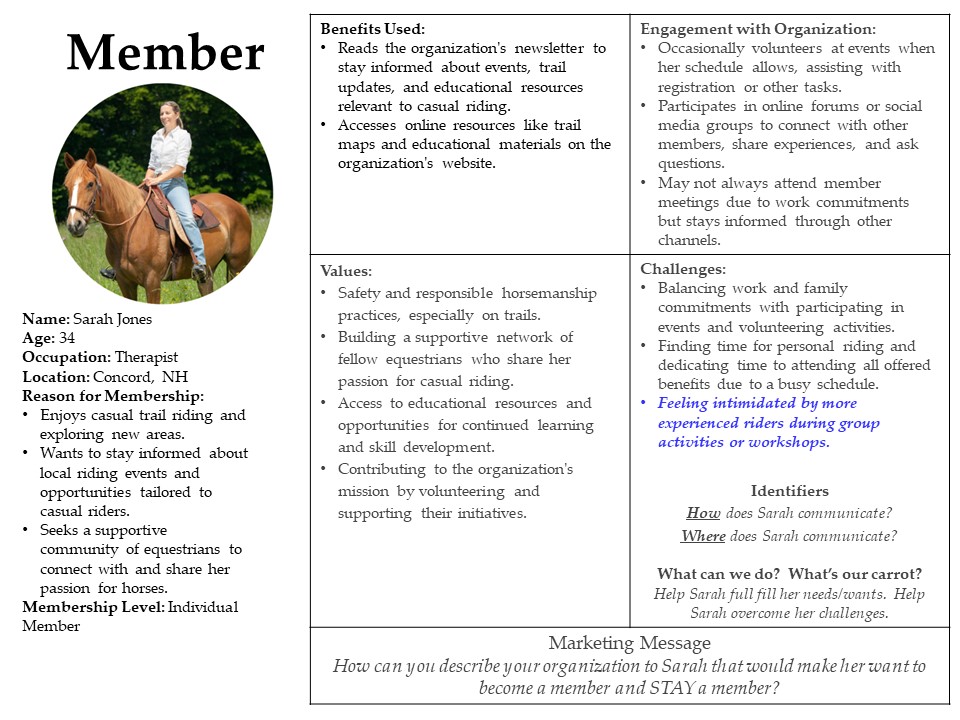
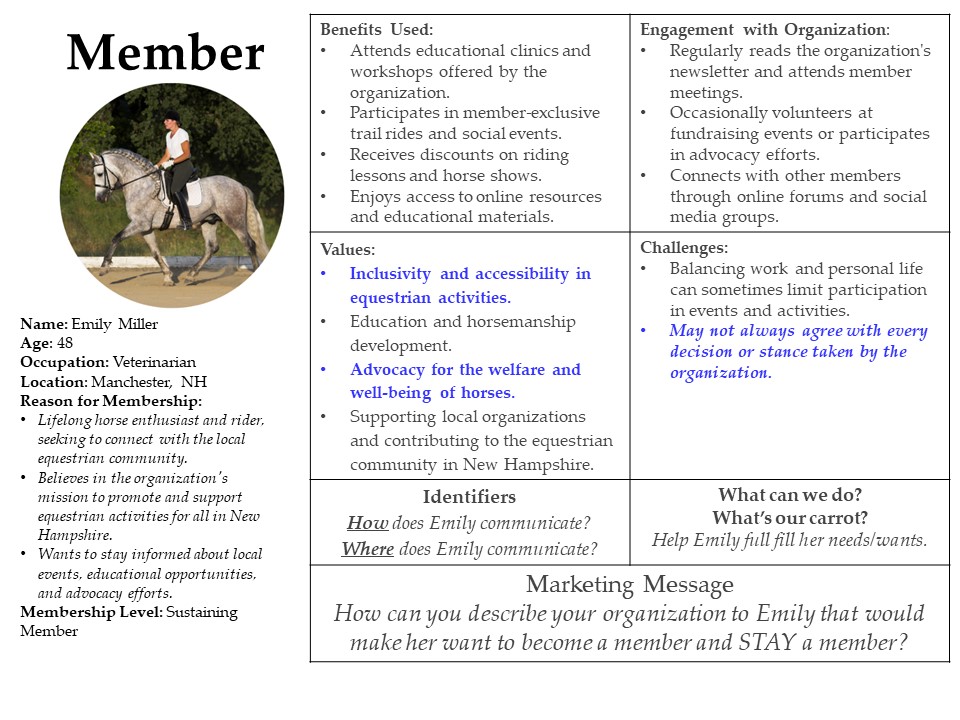
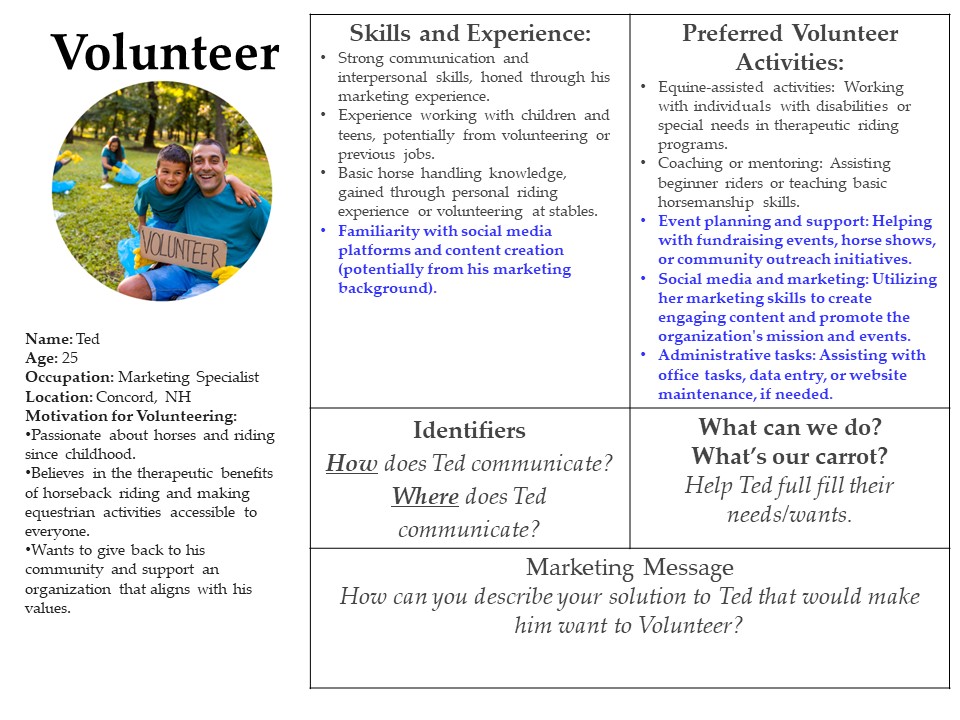
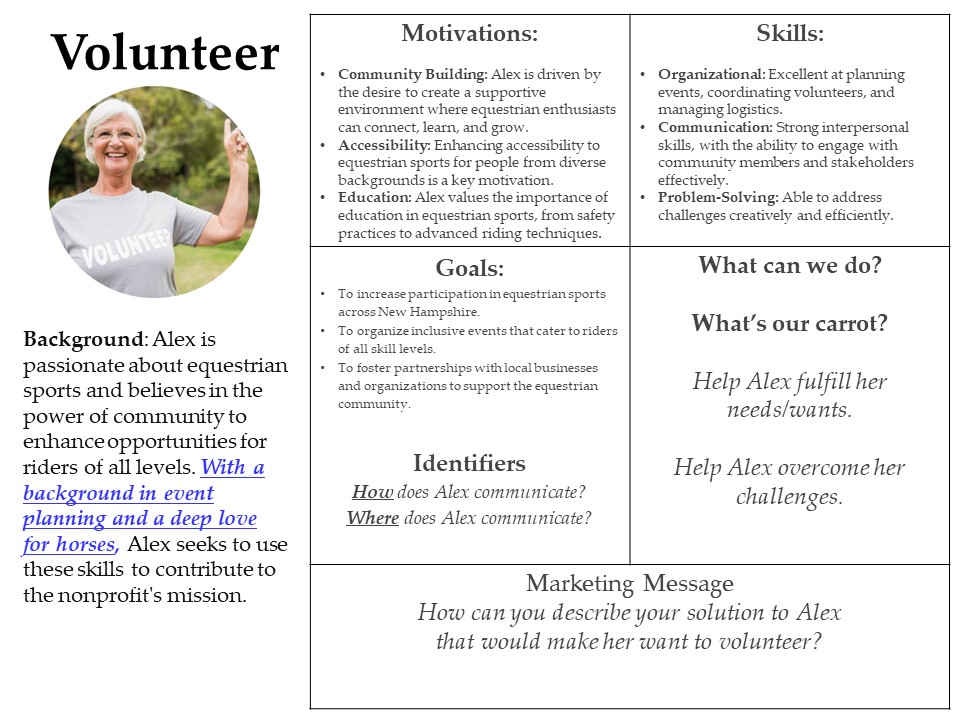
In 2022, I had written a blog post about customer personas and using social media to data mine for information. Customer personas can be extremely useful for creating customer profiles, but they can also be very useful to nonprofits.
You can use the same concept and create volunteer profiles and member profiles (if your NP is membership based) and that can help with recruitment of both. These examples are ones I created for a horse nonprofit organization as examples for a prior presentation.
As follows are two examples each of a volunteer persona and member personas.
S.W.O.T. for Nonprofits:
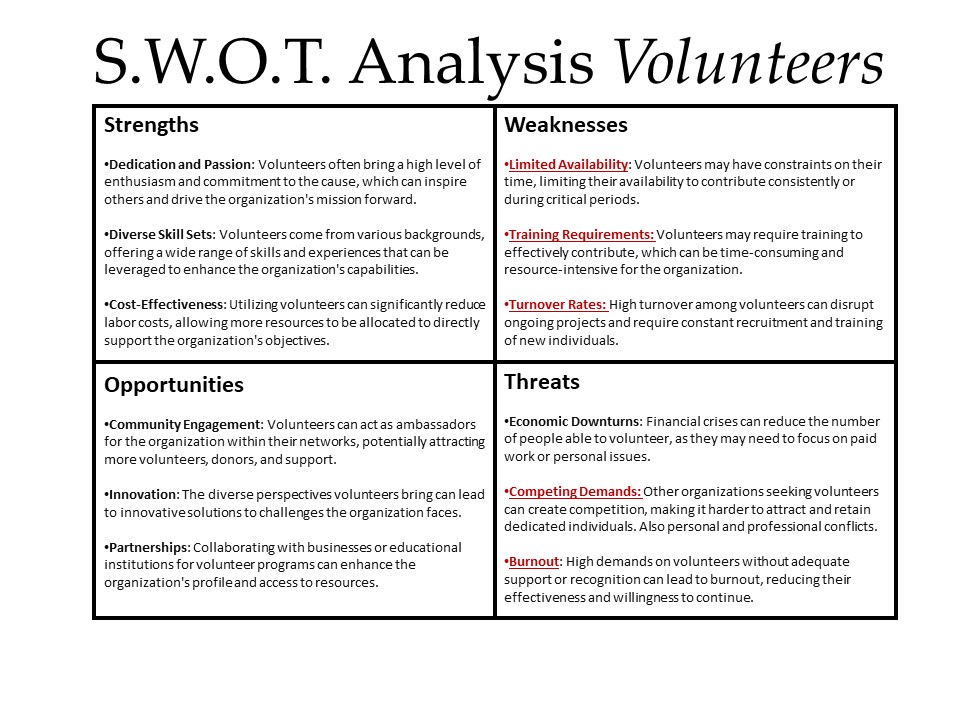
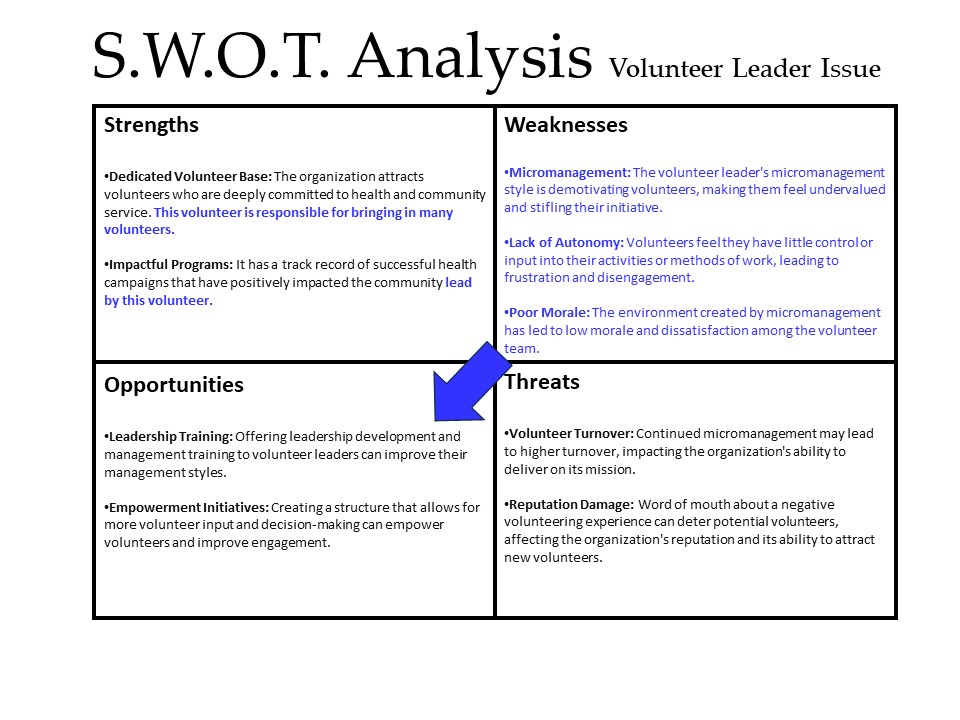
I also want to add, the benefit of using S.W.O.T. (Strengths, Weaknesses, Opportunities, Threats) analysis can also be very useful for a nonprofit and can analyze volunteers, board makeup, volunteer leaders, members, the organization itself, fundraising and help identify things going on in the organization that might need attention.
Having your board of directors do this in conjunction with your Executive Director and Committee Members helps to get lots of insights, different viewpoints and, in many cases, inspiration and direction.
These two examples are ones I’ve done on various nonprofits over the years that I have either volunteered with or worked with as a personal business client.
I hope some of these tools are helpful as an organization goes through their nonprofit journey.